The B2B webinar funnel: six stages for outbound teams
Most webinar funnels assume an audience you already have. This is the outbound B2B webinar funnel in six stages, with one benchmark each.
 Bhaskar Dev20 min read
An outbound webinar funnel lets you decide who is in the room before you send the first invitation, and this guide shows you how to build one and optimize it stage by stage.
Webinars are one of the most effective lead generation strategies in B2B, and one of the easiest to set up. Yet most webinar and marketing teams struggle to make the funnel work. They follow the traditional approach: publish a registration page, promote it to the list they already own, and wait.
We have run thousands of webinars for 250+ B2B and enterprise brands, and Tantra is that playbook turned into software. The data in this guide is backed by our internal metrics from those webinars and by other industry sources, with a clear label on which is which.
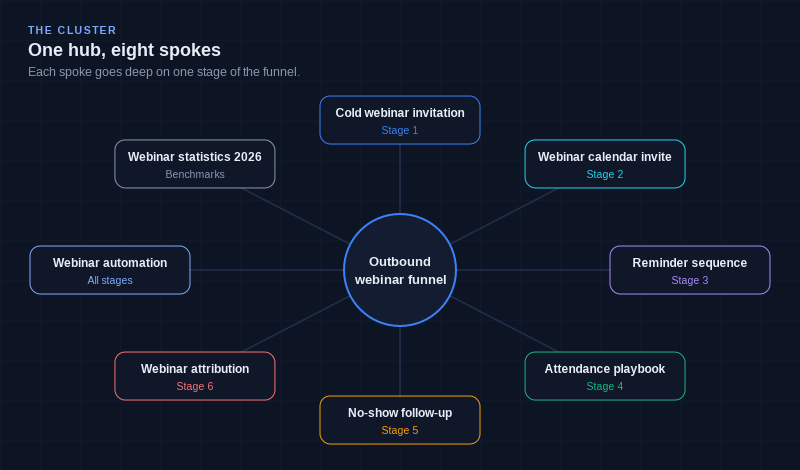
This is a practical deep dive into the problems teams hit at each of the six stages and how to solve them, based on our own experience and industry benchmarks. For the wider plan, from topic to follow-up, read the webinar marketing strategy guide.
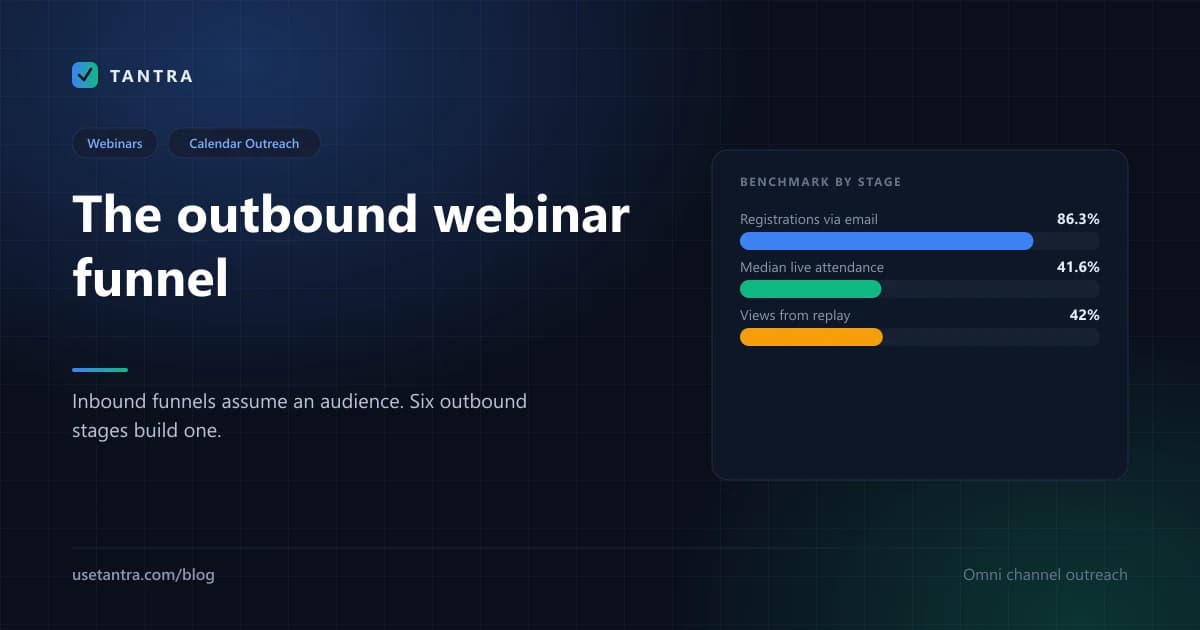
Start with the number that shapes the whole funnel. Contrast's B2B benchmark for the median live attendance rate, covering Q3 2025 to Q1 2026, is 41.6% (reported via VoxBooster). Put plainly, if 100 people register for your webinar, about 42 of them will be in the room. For a team with a mailing list of 20,000 that is a manageable problem. For a team with a list of 800, it is the whole story, because a webinar that needs 50 live attendees needs roughly 120 registrants, and 120 registrants need a much larger group of people who were asked.
That is where most webinar funnel advice stops being useful. The popular versions begin with awareness: content, ads, SEO and social posts that pull strangers toward a registration page. They assume the audience arrives on its own. A B2B team selling to a few hundred named accounts does not have that luxury, and waiting for the audience to find a registration page is not a plan.
For a team working from named accounts, the webinar plan starts with people you want to reach. This guide follows that outbound approach through six stages, from the first invitation to the pipeline review. Each section explains the decision you need to make, gives you a published number for context and points to a separate guide when you are ready to work through the details.
The short answer
An outbound B2B webinar funnel runs in six stages: invite, commit, remind, attend, follow up, attribute. You choose the prospects, invite them across channels, turn interest into a visible commitment such as an RSVP, remind them in several places, run the session, follow up by segment, and then trace the pipeline back to the invited contact. The point is that you control the top of the funnel instead of hoping it fills. Each stage below links to the guide that goes deep on it.
What is an outbound webinar funnel?
In an outbound webinar programme, you build much of the registration list by contacting prospects you have chosen. You decide which accounts and roles would find the session useful, then invite those people directly. The webinar gives you something relevant to offer, and the outreach helps that offer reach the people it was designed for.
The best-known published model is Cvent's webinar funnel, which names five stages: awareness, engagement, evaluation, conversion and post-purchase. It is a sensible inbound model. It treats the webinar as one step in a content journey, with ads and organic reach feeding the top.
The outbound version differs in three ways.
- The top of the funnel is a list, not a channel. You start from a defined set of accounts and roles, not from impressions.
- Commitment gets its own stage. An inbound funnel treats registration as the event. An outbound funnel treats it as one possible commitment, and often a weaker one than an accepted calendar invitation.
- The last stage is attribution to a named contact. Because you know who you invited, you can report pipeline per invited person, which is rarely possible when the top of the funnel is anonymous.
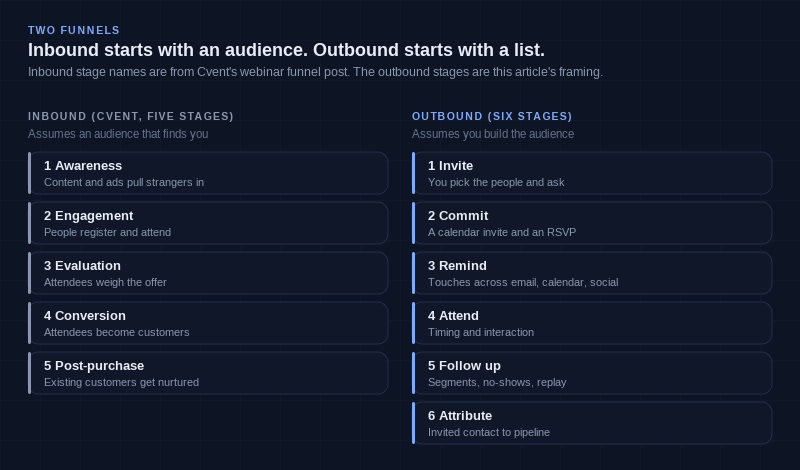
Neither model is wrong. Inbound compounds over time and costs little per head once content ranks. Outbound is faster and works when the audience is small and well defined. Many teams run both: the inbound programme fills the top with whoever shows up, and the outbound programme fills it with the accounts that matter most. This article is about the second.
Webinars still earn the effort in B2B. The Content Marketing Institute's B2B research, as quoted by Cvent without a year, put webinars as the second-most effective distribution channel at 51%, behind in-person events. Treat that as old context, not a current benchmark.
Where does the funnel start, and who gets invited?
Before writing the first invitation, decide who belongs on the list and how many people you need to reach. A good subject line helps once you have a relevant audience, but it cannot make up for inviting people who have little reason to care about the session.
Work backwards from the room. If you want 50 live attendees and use Contrast's 41.6% median live rate, you need about 120 registrants. If you then assume, purely as a hypothetical, that 3% of the people you invite end up registering, you need about 4,000 invited contacts. Change the assumption to 6% and it halves. The 3% is a cautious illustration for a generic invitation, not a benchmark. Personalization moves it more than anything else: in our own campaigns, cold invitations hyperpersonalized to each prospect typically draw a response rate of about 30%. A generic template sent to the same list draws about 10%, and even that beats the generic cold email invitations used in traditional marketing. Your own first campaign will replace these figures with a real one.
The best route: personalized outreach, then a calendar invitation. You do not need ads to fill a B2B webinar. Build the people data for your ICP from tools like ZoomInfo and Apollo and upload it to Tantra. Tantra runs the outreach: sequences across email, LinkedIn and WhatsApp, with AI personalization writing each email. When someone registers, a Google Calendar invitation puts the session on their agenda. Connect your webinar platform, such as Zoom or WebinarGeek, and measure campaign effectiveness, attribution and attendance rate, all in Tantra. The webinars use case shows the full setup.
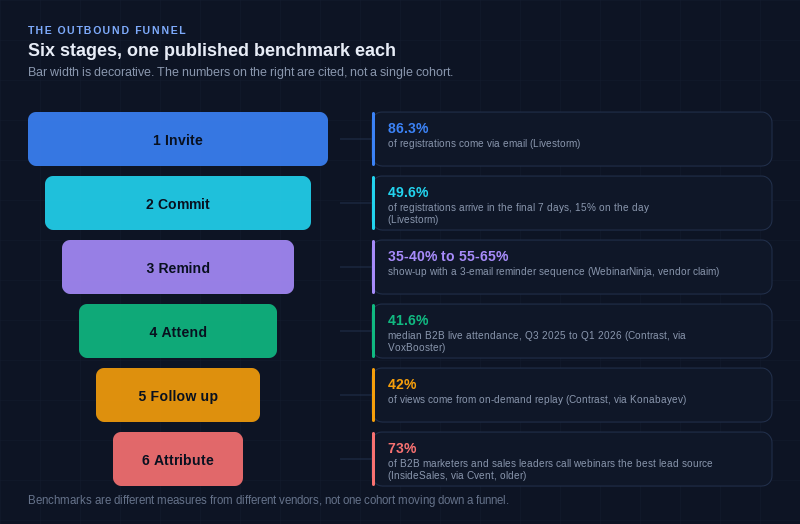
Email is the workhorse of this stage. Livestorm's webinar best-practice data attributes 86.3% of registrations to email, against 43.3% for organic social. The two shares add up to more than 100%, because a registrant can be credited to several sources, so read them as "how often each channel was involved", not as a split of one pie. Email dominates, and the social channels add reach on top of it.
For a cold audience, the invitation also has to survive three tests: it must reach the inbox, it must say why this person should care, and it must make the ask small. A webinar is a lower-commitment offer than a demo, which is why it suits a first touch. The full treatment, with templates for email, LinkedIn and WhatsApp, is in how to invite cold B2B prospects to a webinar. If you send from your own mailboxes, the deliverability groundwork in the Gmail Primary inbox guide and the Google Workspace setup manual applies before a single invite goes out.
A reply, a click or a registration gives you something to work with at the end of this first stage. Each signals a different level of interest. The next steps help that person move from noticing the invitation to setting aside time and actually joining the session.
How do you turn interest into a commitment?
Stage two is where the outbound funnel departs most from the inbound one. A registration form is a request that the prospect do something. A calendar invitation puts the event on their agenda, and the response is a visible commitment: yes, no or maybe.
The timing data shows why early commitment matters. Livestorm reports that 49.6% of registrations arrive in the final seven days before an event, and 15% on the day itself. That is a lot of people deciding late, and it means a large share of your eventual audience is one reminder away from forgetting. A commitment made earlier, and recorded on a calendar, protects against both problems: the person decided, and the event exists where they plan their week.
An "add to calendar" link only works if the registrant clicks it, and you cannot see whether they did. A real invitation arrives as a calendar event with native reminders, and each RSVP is a data point you can act on. A yes gets a light touch. A maybe gets a stronger reason to come. A no is information, not failure, and it can route to the replay track.
There is a caution to keep in mind. An RSVP is a statement of intent, not attendance. Treat it as an early forecast and check it against the attendance data later; the gap between the two is one of the more useful numbers your first few events will give you. Also remember that every calendar invitation counts against Google's daily sending limits; how calendar invitations are batched and sent covers how Tantra paces them.
The comparison of links and invitations, the exact steps and what to put in the invite are in webinar calendar invites vs. add-to-calendar links.
What should happen between the commitment and the event?
Once someone has committed, you still need to help them remember. They may have registered days before the session, and their schedule may have changed since then. The reminder sequence gives the webinar a chance to stay visible through the everyday work that would otherwise push it out of mind.
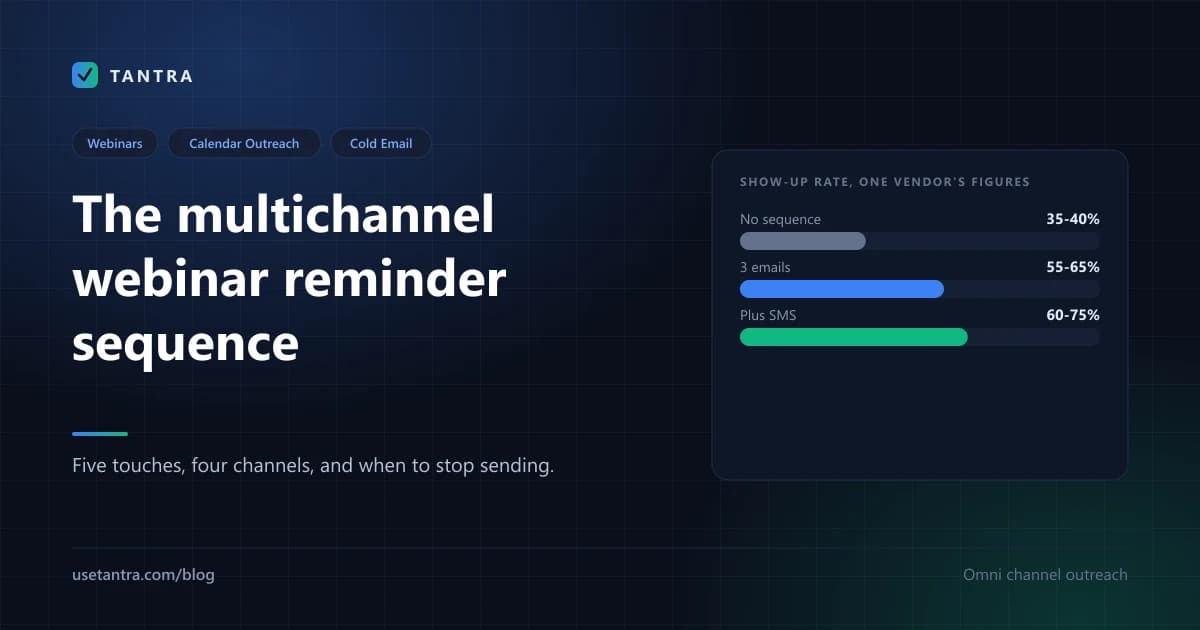
Published schedules vary. Kaltura recommends reminders one week, one day and one hour before. Cvent's checklist suggests emails at eight, four and two days before. WebinarNinja, a vendor selling webinar software, claims that a three-email reminder sequence moves show-up from 35 to 40% to 55 to 65%, with a further 5 to 10% from an SMS 15 minutes before the start. That is one vendor's own figure, so treat it as directional rather than a promise. Our own experience points the same way and more sharply for outbound: for a cold-invited audience, attendance drops by about 80% when no reminder emails go out.
For an outbound audience, the interesting move is to stop thinking of reminders as emails. Prospects you invited by LinkedIn message may answer there faster than they ever open an email. A calendar invitation reminds them natively. A short WhatsApp message on the day, to people for whom that channel is appropriate, can do what a fourth email cannot, and in our campaigns the ones with automated WhatsApp follow-up show higher attendance. The discipline is one channel per touch, and stopping the sequence for a person the moment they reply or decline.
WhatsApp automation. Tantra can send bulk messages and reminders from a normal WhatsApp account or a WhatsApp Business account. You do not need to buy the WhatsApp Business API, and the setup takes about three minutes. One thing to remember: use a WhatsApp account you can afford to lose, because WhatsApp can block a number when recipients report its messages.
Use the middle reminders to help people remember why they wanted to attend. Name a useful takeaway, a question the speaker will answer or a resource they can use afterwards. Keep the date and join link easy to find, but give each message enough substance to be worth opening.
A late registrant is a special case. With nearly half of registrations landing in the last week, the sequence has to compress gracefully for people who join with two days to go. The multichannel schedule, the templates and the stop rules are in the multichannel webinar reminder sequence.
How do you keep people in the room?
Stage four is the session itself. This is the one stage where outreach software has the least to say, and the content, speaker and format carry most of the weight.
Two numbers frame the realistic target. Contrast's median live attendance of 41.6% is the B2B figure that fits this funnel best. ON24's broader 2026 benchmarks, quoted via VoxBooster, put registration-to-attendance at 60% when live and on-demand viewing are counted together. The two measure different things, and neither is a target to hit blindly; they are a range that tells you what normal looks like. If your live rate is far below the median, look at scheduling and reminders before the content.
Our own research and Tantra data point the same way, with a sharper answer: webinars run in the first half of the day on Wednesday and Thursday work well. For the other days, rule out weekends, and rule out Monday, when schedules are busiest.
What you do in the session decides how much of the audience stays. Livestorm's data shows average webinar length around 68 minutes against 26 minutes that attendees actually stay, which is a sharp reminder to put the point early and keep the format tight. Contrast, through the same VoxBooster summary, reports that 85% or more of attendees complete a 30-minute webinar while only 37% stay a full 60 minutes. Interaction helps, and the same Livestorm data reports averages of 85 chat messages, 20.4 questions and 2.8 polls per session.
During the session, pay attention to questions, poll responses and how long people stay. Those details help the team decide what to send afterwards and which conversations deserve a personal response. Capture them while they are available so the follow-up can reflect what each attendee actually did.
Timing, slide design, interaction and the benchmarks are covered in the B2B webinar attendance playbook, which is the reference for this stage, so we will not repeat its detail here.
Who gets what after the webinar?
After the session, you can return to the people you invited with something relevant to share. You already know their name, company and the message that started the conversation. That context helps you follow up with attendees and with people who were interested enough to register but could not make the live time.
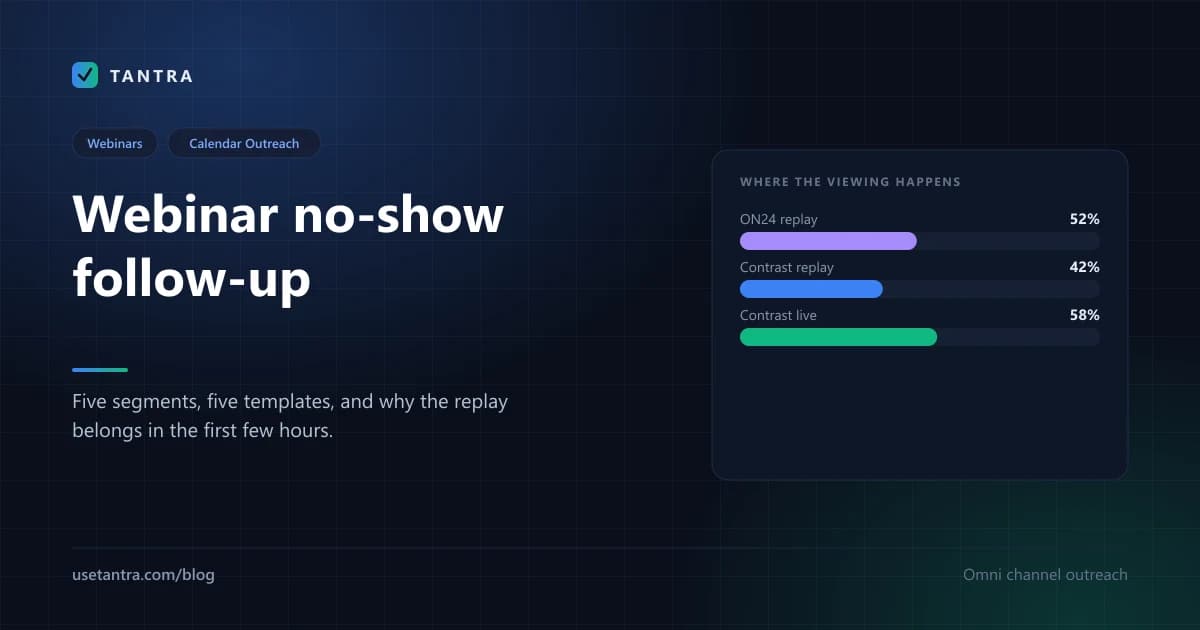
The replay is a large part of the audience. Contrast reports that 42% of webinar views come from on-demand replay, as summarised by Konabayev; ON24's own figure, via Stealth Agents, puts the on-demand share of attendance at 52%. The bases differ, but both say that a funnel which stops at the live session ignores a big share of the viewing.
Follow-up is also where many teams struggle. Livestorm's survey found 38.2% of webinar practitioners name post-event follow-up as a top-three challenge. That is an operations problem as much as a copywriting one: someone has to know who attended, who left early, who watched the replay and who said no, and send each group something different. It is worth the work. In our campaigns, follow-up after the webinar is where interest turns into action, and it shows higher conversion than a single thank-you email.
The segmentation that works is simple. Attendees get a recap and a next step. People who left early or watched only part get the section they missed. No-shows get the replay, framed as value rather than reproach. People who declined get a lighter touch or nothing. Anyone who replies is taken out of automated sequences and handed to a person.
Two cautions. First, the first message to a no-show should not be a pitch. Second, a registrant who replies to a follow-up is no longer a sequence recipient, so the system sending the follow-up needs to notice replies across channels. The segments, timing and templates are in webinar no-show follow-up across channels.
How do you tie the webinar to pipeline?
Stage six is attribution, and it is where outbound has a structural advantage. Because you invited named contacts, you can match three records for each person: the outreach record, the webinar platform's attendance record and the CRM's opportunity record.
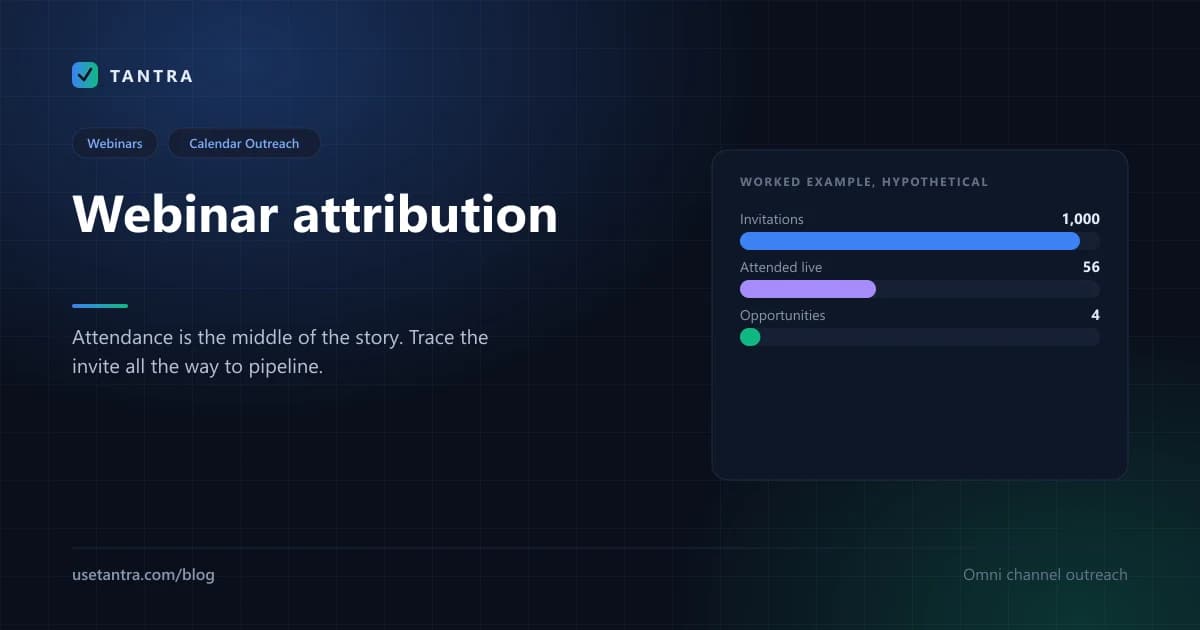
Most webinar reporting stops at attendance, which is the middle of the story. A complete view follows the contact from invitation to reply, RSVP, registration, attendance, engagement, and finally pipeline. That lets you answer questions that aggregate numbers cannot: which invitation channel produced the registrants who actually attended, whether a yes RSVP predicts attendance for your audience, and how many opportunities trace back to a given event.
One metric to leave out is the open rate. Email opens are measured through image requests that privacy proxies and security scanners trigger without a human reading anything, so they are a poor basis for judging a webinar campaign. We explain why in why we don't track email opens and describe better measures in outreach KPIs beyond open rates.
The older quantitative evidence for the whole exercise is thin and dated. The 73% of B2B marketers and sales leaders who told InsideSales that webinars are the best way to generate high-quality leads comes to us through Cvent, with no year attached, so use it as context rather than proof. Your own invited-contact data will be worth more than any survey within two or three events.
The metrics, the matching approach and a worked example from 1,000 invites to pipeline are in webinar attribution, from invite to pipeline.
How do you automate the funnel without losing the human parts?
As the programme grows, small manual tasks start to delay the next step. Someone has to export the form submissions, add names to a campaign and copy attendance records into the CRM. Connecting those handoffs to the relevant events helps you keep up with registrations without relying on someone remembering each task at the right moment.
The pattern is the same throughout. An event in one system, such as a form submission, an RSVP or an attendance update, fires an action in the next: enrol a contact, register them with the webinar provider, update a CRM stage, or pause a sequence. What should stay manual is the judgement: who counts as high intent, what to say to a senior buyer who asked a hard question, and whether a webinar is the right offer for an account at all.
Automation also introduces its own failure modes, including duplicate enrolments, time zone mistakes and consent gaps, so test each hook with a small batch before pointing it at a full list. The recipes and the failure modes are in webinar automation, from form fill to calendar invite to CRM.
What benchmarks should you hold each stage to?
Published numbers can help you choose what to investigate in your own funnel. Before treating one as a target, check the sample, year and definition, and whether the audience resembles yours. Several of the figures below are available to us through secondary sources, so keep that limitation alongside the number.
| Stage | Benchmark | Source and caveat |
|---|---|---|
| 1. Invite | 86.3% of registrations driven by email; 43.3% by organic social | Livestorm. Sources overlap, so the shares exceed 100% |
| 2. Commit | 49.6% of registrations in the final 7 days; 15% on the day | Livestorm |
| 3. Remind | Show-up 35 to 40% rising to 55 to 65% with a 3-email sequence | WebinarNinja, a webinar vendor's own claim |
| 4. Attend | 41.6% median live attendance (46.2% mean), Q3 2025 to Q1 2026 | Contrast, via VoxBooster |
| 5. Follow up | 42% of views from on-demand replay | Contrast, via Konabayev |
| 6. Attribute | 73% say webinars generate the best leads | InsideSales, via Cvent. Older, no year given |
Where numbers disagree, our webinar statistics for 2026 reconciles them in more detail. First-party show-up and registration-timing data from webinars linked to Tantra is in the webinar marketing strategy guide. When your own events produce these numbers, they should replace ours.
What do we see in our own outbound campaigns?
Read the table above with one caveat. Most published benchmarks describe webinars promoted to an audience that already knows the host, through funnels whose setup the source does not describe, so nobody outside can tell how well each one was optimized. Show-up is higher for an existing audience. Cold invitation is a different game, and these are the observations from our own webinar outreach for 250+ brands. They come from practice, not from a published study.
| Stage | What we see |
|---|---|
| Invite | Hyperpersonalized cold invitations typically draw a response rate of about 30%, against about 10% for a generic template |
| Remind | For a cold-invited audience, attendance drops by about 80% when no reminder emails go out |
| Remind | Campaigns with automated WhatsApp follow-up show higher attendance |
| Follow up | Follow-up after the webinar shows higher conversion |
Our verdict: focus on marketing, outreach and reminders, and attendance follows. The webinar creates interest. The post-webinar email turns that interest into action.
Where Tantra fits
Tantra can act as your webinar marketing platform across all six stages. You run the session on Zoom, WebinarGeek or the platform you already use, and Tantra runs the outreach on either side of it.
- Invite on every channel. Tantra sends invitations by email, LinkedIn and WhatsApp, and puts the session on registrants' calendars with Google Calendar invitations. Connect unlimited email and calendar accounts. Build as many sequences as you need, and each one can cover any mix of channels.
- Make every invitation one to one. Tantra reads each prospect's website, then AI personalization writes the invitation email and the calendar invitation description for that person. LinkedIn and WhatsApp steps are personalized with merge tags and spintax. Invitations written this way bring more people into the webinar.
- Turn a Yes into a registration. When a contact answers Yes or Maybe to a Calendar invitation, Tantra can register them on your webinar platform automatically, once you switch that on for the campaign. Zoom and WebinarGeek are direct integrations. Other platforms, such as WebinarNinja, connect through a webhook or an AI agent.
- Catch landing page sign-ups too. When someone fills in the form on your own registration page, an inbound webhook adds them to a Tantra campaign through prospect intake, so their calendar invitation and reminder emails start without anyone exporting a list.
- Measure the whole funnel. Replies from every channel land in the unified inbox, attendance comes back from Zoom or WebinarGeek by contact when you refresh it, and the reports show which campaign and sender filled the room.
Prospect lists come in through prospect intake, and webhooks, a REST API and an MCP server connect the funnel to your CRM, as the developer page lists. The webinar use case shows how the pieces fit together.
Frequently asked questions
What is a B2B webinar funnel?
It is the path a prospect follows from first hearing about a webinar to becoming pipeline: invitation, registration or RSVP, attendance, follow-up and conversion. Published models such as Cvent's start with awareness; the outbound version starts with a chosen list of prospects and adds explicit commitment and attribution stages.
How is an outbound webinar funnel different from an inbound one?
Inbound relies on content, ads and search to bring people to a registration page. Outbound relies on you contacting selected prospects directly by email, calendar invitation, LinkedIn or WhatsApp. Outbound is quicker to start and suits small, well-defined audiences, while inbound builds up more slowly and costs less per head over time.
How many people do I need to invite?
Work backwards. Divide your target live attendance by an attendance rate such as Contrast's 41.6% median to get the registrants you need, then divide by the share of invitees you expect to register. The registration share is yours to measure; the 3% in this article is a hypothetical, not a benchmark.
What is a good webinar attendance rate for B2B?
Contrast reports a 41.6% median live attendance for B2B (Q3 2025 to Q1 2026). ON24 reports 60% when live and on-demand viewing are combined, via VoxBooster. They measure different things, so compare like with like.
How long before the event should I start inviting?
An older GoTo finding, quoted via HubSpot, was that promoting four or more weeks ahead produced 12% more registrations. It is dated and from a webinar vendor, so test it. Because 49.6% of registrations arrive in the final seven days, plan for both an early wave and a late one.
Which metric matters most?
Registrant-to-attendee rate and the pipeline traced to invited contacts matter more than opens. Open tracking is unreliable, as explained in our KPI guide.
Key takeaways
- Inbound funnels assume an audience. The outbound version starts from a list you chose.
- Six stages: invite, commit, remind, attend, follow up, attribute.
- Work backwards from the room. At a 41.6% median live rate, 50 attendees need about 120 registrants.
- Commitment is its own stage. A calendar RSVP is visible; an add-to-calendar click is not.
- Nearly half of registrations arrive in the last week, so reminders and late-joiner sequences matter.
- Replay is a large share of viewing, so follow-up reaches no-shows, not only attendees.
- Attribute to the invited contact, not to an open rate.
- Treat every benchmark as a hypothesis, and replace it with your own data. Most describe existing audiences, not cold invitations.
- Our verdict: focus on marketing, outreach and reminders, and attendance follows. The post-webinar email turns interest into action.
Sources
- Cvent, webinar funnel: the five inbound stages; the InsideSales 73% and Content Marketing Institute 51% figures, quoted without years.
- Livestorm, webinar best practices: registration timing and channel shares, session length and interaction averages, follow-up challenge (vendor data, 2026 edition).
- Contrast benchmarks (Q3 2025 to Q1 2026), via VoxBooster for live attendance and completion, and via Konabayev for the 42% replay share. Secondary sources, original not checked.
- ON24 2026 benchmarks, via VoxBooster and Stealth Agents. Secondary sources.
- WebinarNinja, webinar best practices: reminder and SMS lift. Vendor claim.
- Kaltura, webinar best practices, and Cvent, webinar checklist: reminder schedules.
- GoTo, via HubSpot: promotion lead time. Older data, via a secondary source.
- Tantra campaign experience: the response rate of about 30% on hyperpersonalized cold invitations, the drop of about 80% in attendance without reminder emails for a cold-invited audience, and the higher attendance and conversion with WhatsApp follow-up and post-webinar follow-up. Observations from our own webinar outreach for 250+ brands, not a published study.
The 3% registration share and the 4,000-invite figure are a worked hypothetical, not data. Benchmarks from different vendors use different samples and definitions, so use them to form hypotheses and test them on your own events.
About the author

Bhaskar Dev
Co-founder, Tantra · Bengaluru, India
Bhaskar Dev is a serial entrepreneur, engineer-turned-marketer, and Co-founder of Tantra. With over a decade of experience in B2B technology marketing and growth, he specialises in building AI-powered marketing systems, scaling SaaS businesses, and turning complex technologies into market-ready ventures. His work spans deep-tech, IoT, MarTech, and AI-driven automation.
Connect with Bhaskar on LinkedIn.