
Manage leads, stages, and scores
Track prospects in Tantra's leads view, set stages, read the automatic engagement score, and open a lead's activity, notes, and campaigns.
Open in Tantra
These open the app in a new tab. You may be asked to sign in.
Overview
The leads view is your pipeline of prospects. Each lead has a stage you can set, a score that updates automatically as the prospect engages, and a profile with their activity, notes, and campaigns. This is where you turn replies into next steps after you spot them in the inbox.
How it works
Every contact you email becomes a lead. As Tantra records activity, such as a send, a click, or a reply, it updates that lead's score and can move its stage. You can also set a lead's stage yourself at any time. For how activity is detected, see Reply detection and intent classification.
The score
The score is a running number that reflects engagement. Tantra adjusts it automatically each time it records an activity:
| Activity | Score change |
|---|---|
| Email sent | +1 |
| Link clicked | +3 |
| Positive reply | +15 |
| Neutral reply | +10 |
| Negative reply | +5 |
| Bounce | -5 |
| Unsubscribe | -10 |
A reply of any tone adds to the score, because any reply is engagement. A bounce or an unsubscribe subtracts from it. Note that even a negative reply adds points, since the prospect engaged, so read the score together with the stage and the reply intent rather than on its own.
The stage
The stage is a label for where a lead sits in your pipeline. You set it from a picker with these options:
- New
- Contacted
- Engaged
- Replied
- Positive Reply
- Negative Reply
- Meeting Booked
- Converted
- Lost
- Unsubscribed
Tantra also updates a lead's stage automatically as it records activity like sends, clicks, and replies, so a lead can move without you touching it. You can always override the stage by hand.
Before you start
- You need contacts. Import them first if your list is empty. See Import contacts from CSV.
- Scores and stages only start moving once your campaigns send and prospects engage.
Step-by-step
- Open Leads from the main navigation.
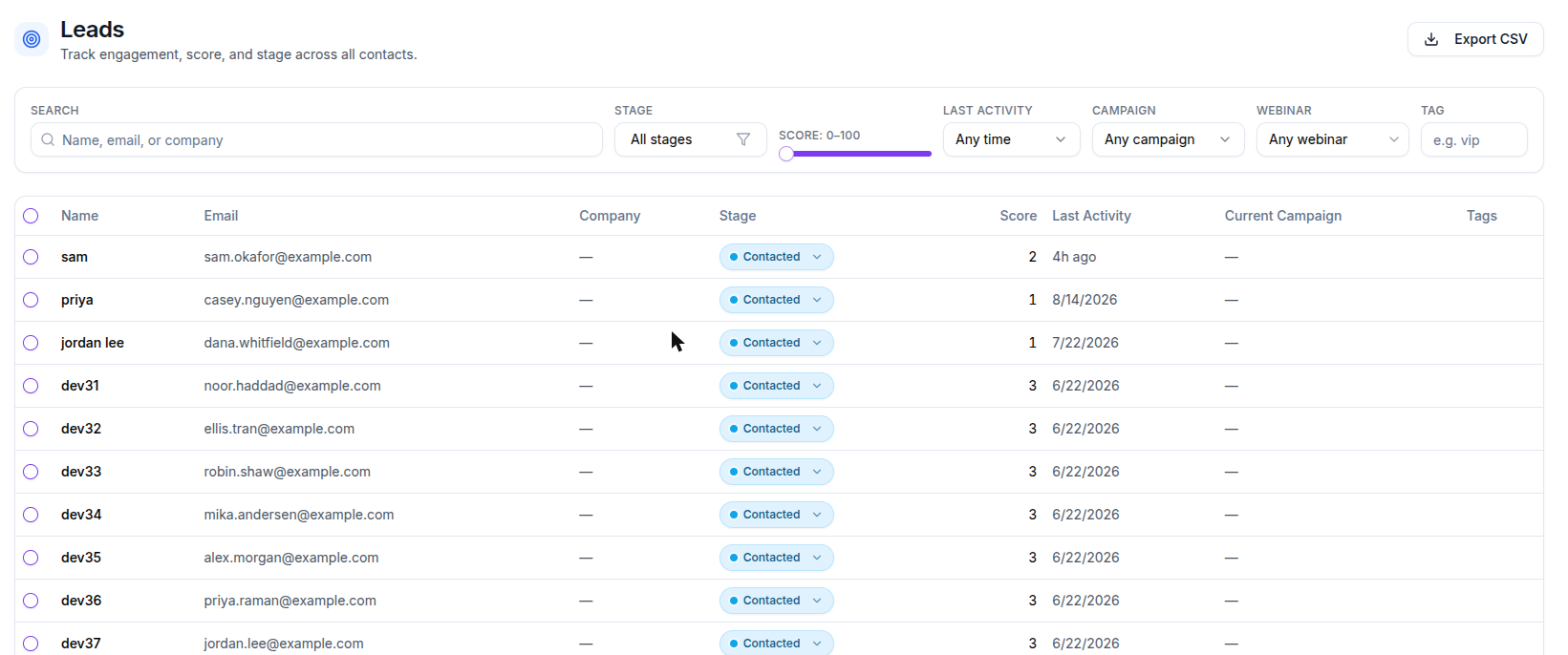
- Use the filters to focus the list: search by Name, email, or company, filter by stage, drag the score range slider, choose a last-activity window, or filter by campaign or tag.
- Click any row to open the lead profile on the right.
- In the profile, set the Stage, read the Score, and switch between the Activity, Notes, and Campaigns tabs.
- From the profile footer, use Add to suppression to stop contacting that person.
- To update many leads at once, select their checkboxes and use Set stage to... in the selection bar.
Screens and controls
- Export CSV. Downloads the leads on the page you are viewing as a CSV file named
leads-YYYY-MM-DD.csv. It is the current page rather than the whole filtered set, so page through and export again if you need more. - Filters. Search (Name, email, or company), a stage multi-select, a Score range slider from 0 to 100, a last-activity window (Any time, 24h, 7d, 30d, 90d), a campaign filter, a Webinar filter grouped by provider, and a tag filter. A summary shows how many filters are active and how many leads are showing, with a Clear all control.
- Table. Columns are select, Name, Email, Company, Stage, Score, Last Activity, Current Campaign, and Tags. When empty it shows No leads yet. Import contacts to get started. or No leads match your filters.
- Selection bar. When you select rows, a bar shows the count with a Set stage to... picker and Clear selection.
- Pagination. Choose 10, 20, 50, or 100 rows per page, with page controls.
- Lead profile. A drawer with the lead's name and email, a Stage picker, the Score, and three tabs: Activity, Notes, and Campaigns. Editing the stage here works the same as editing it in the table.
- Not available yet in the drawer. The Activity tab shows a placeholder rather than a full timeline, Open conversation stays greyed out, and Unenroll from all does not stop sending. To act on a lead today, use Add to suppression in the drawer, or open the conversation from the Inbox and use Stop sequence in its thread panel. To unenroll from a single campaign, open that campaign and use its enrollment controls.
Field reference
| Control | What it does |
|---|---|
| Stage picker | Sets the lead's pipeline stage |
| Score | Read-only engagement number that updates automatically |
| Set stage to... | Sets the same stage on every selected lead |
| Export CSV | Downloads the leads on the current page as a CSV |
| Open conversation | Opens the lead's latest email thread in the inbox |
| Add to suppression | Suppresses the lead so campaigns stop emailing them |
| Unenroll from all | Not working yet. It reports success without stopping any sequence |
What happens next
- A stage you set by hand saves right away. A bulk stage change applies to each selected lead in turn, and Tantra reports if any did not update.
- Add to suppression stops future campaign emails to that lead. See Suppression lists and unsubscribes.
- Unenroll from all is not connected yet. It reports success but does not stop a sequence, so use Stop sequence on the conversation in the Inbox instead.
- Scores keep updating automatically as Tantra records new activity, so a lead's number can change between visits.
Best practices
- Filter by stage and score together to find your warmest leads, then work them from the profile.
- Use tags to group leads for a filter, for example a target account list.
- Read the score alongside the reply intent, since a negative reply still raises the score.
Common mistakes
- Treating a high score as interest. A negative reply raises the score too. Check the stage and the reply intent.
- Relying on Unenroll from all to stop a sequence. It does not, despite the success message. Suppress the address, or stop the sequence from the conversation in the Inbox.
- Expecting a full activity timeline everywhere. On some setups the profile shows partial activity rebuilt from email threads.
Troubleshooting
| Symptom | Cause | Fix |
|---|---|---|
| The Activity tab shows "Activity timeline coming soon (Phase 2)." | The full activity feed is not enabled on this backend | Use the Campaigns tab and the inbox to trace the lead's history |
| The Notes tab shows "Notes log isn't enabled on this backend." | The notes feature is not enabled | Track notes elsewhere for now |
| A score looks high for a cool lead | Replies and clicks add points regardless of tone | Read the score with the stage and reply intent, not alone |
| A bulk stage change did not apply to every lead | One or more updates failed | Re-select the affected leads and set the stage again |
| No leads at all | No contacts imported, or campaigns have not sent | Import contacts and launch a campaign |
FAQ
Is the score something I set?
No. The score updates automatically from engagement. You set the stage, not the score.
Why did a negative reply raise a lead's score?
Any reply counts as engagement, so a reply of any tone adds points. Use the stage and the reply intent to judge quality.
Can I change many leads at once?
Yes. Select their checkboxes and use Set stage to... in the selection bar.
How do I stop sending to one person?
Use Add to suppression in the lead profile. That blocks future campaign email to their address and cannot be undone from this screen. To stop an in-flight sequence for that person, open their conversation in the Inbox and select Stop sequence in the thread panel.
Where does a lead's reply history come from?
From the email threads Tantra detected. Open the lead's conversation from the profile to read it. See Use the threaded inbox.
Can I export my leads?
Yes. Export CSV downloads the leads on the page you are viewing to a file named leads-YYYY-MM-DD.csv. Page through and export again to capture the rest.
Related articles
Was this article helpful?
Related articles
- Reply intents explainedUnderstand the reply intents Tantra assigns, from interested to unsubscribe request, and how they map to the tone badges in your inbox.
- Use the unified inboxRead and filter email, LinkedIn, WhatsApp, and Telegram conversations in one inbox and view every conversation with the same person.